SQL Server, Power BI, and other Business Intelligence and data technologies

Tag: Power BI (Page 1 of 2)

Adding a Non-Email Enabled Object to Power BI Gateway Cluster Users

The Power BI On-premise Enterprise Gateway allows for users to be added as administrators of the gateway cluster via the Powerbi.com portal.

One annoying quirk about this, however, is that at least as of this writing, it is impossible to add users (or groups) which do not have an email address via the user interface.

Attempting to do so will give the error message “These email addresses are invalid or duplicate.” Pretty annoying!

It turns out that it is actually possible to add objects which do not have email addresses associated with them (groups, users, even application SPNs), however it must be done with PowerShell.

Continue reading

Authenticating to the Power BI REST API with C# via SPN (Part 2 – C# Application)

This post will be a quick primer on authenticating to the Power BI REST API utilizing a C# console application with SPN authentication (Application ID / Client Secret) and utilizing the MSAL library.

For anybody that has followed my previous posts this method is going to be largely similar with only minor differences in the key details. SPN authentication is preferred over Username / Password authentication as it allows the console application to truly authenticate as an application and not “as a user.” This is a much more secure and better method (though it is hasn’t always been available and some API functions don’t yet support this method, sadly). Authenticating via the MSAL library instead of the ADAL library is preferred as Microsoft has announced the termination of support for the ADAL library, so best to keep with the times.

Continue reading

Exploring SQL Saturday Data – Getting the Data

Data for SQL Saturday events is maintained via the sqlsaturday.com website. The site makes available an XML feed for each event which includes all of the basic information for the event, including information about the event, venue, sponsors, speakers, and sessions. The data is available freely from the SQL Saturday website without the need to log in or authenticate to the site.

While getting data for an individual event is pretty straightforward (thanks to the handy XML file), there are some nuances to the process and the data which complicate things somewhat.

The SQL Saturday Website Upgrade

The most notable factor is when the event occurred relative to the SQL Saturday website upgrade. The website upgrade went live at the beginning of April, 2015. For events that were created and occurred before this time, their data would need to be upgrade or recreated in the new site (I’m not sure what process they followed, but it was not smooth for historical events). For anything post-upgrade, those events would natively exist in the new system, so the data will generally be better and more complete.

Screenshot from the old sqlsaturday.com website from before the April 2015 upgrade.
Continue reading

Exploring SQL Saturday Data – A Power BI Analysis

In October of 2013, I attended a SQL Saturday event in Charlotte, NC presented by Julie Smith and Rob Volk titled “Harvesting Web Data Using Power Query & Other Tools” (the link to the session has since broken).

Julie Smith and Rob Volk presenting ” Harvesting Web Data Using Power Query & Other Tools”

In the session, Julie and Rob downloaded data about SQL Saturday events from the sqlsaturday.com website using two different methods.

Continue reading

Microsoft Power BI Certification Exam (DA-100) Beta Available

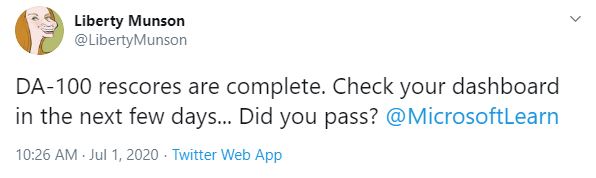
Got some extra time on your hands during the various stay-at-home orders? It was just announced via the Microsoft Learn Blog that the beta for the new Power BI certification exam, DA-100 “Analyzing Data with Microsoft Power BI,” is now available for scheduling. This exam is a replacement for the older 70-778 “Analyzing and Visualizing Data with Microsoft Power BI” which is in the process of being retired. Passing this exam grants the new “Data Analyst Associate” certification.

I just finished registering for a remote exam later this month. If you’re interested as well, act quickly and sign up now! These types of things don’t tend to last long (300 slots available only).

As this is a brand new exam in beta, the cost for registration is 80% of the normal cost (and upon completing the exam, you receive a 25% off coupon for taking the exam in the future if needed). Of course, being brand new, there are no study guides, so preparing for the exam is much more of a challenge than an exam that has been out in the wild for some time with plenty of published resources. Good luck!

Resources

Microsoft Born to Learn Post with Voucher Code and Registration Link

Microsoft Certification Changes

This past Thursday, Microsoft announced upcoming changes to their certification program. Notably, the program is being revamped and the previous certifications — MCSE, MCSA, and MCSD are being retired as of June 30, 2020.

This isn’t the first time MCSE and MCSA have been retired. Prior to 2012, these existed as Microsoft Certified Systems Engineer and Microsoft Certified Systems Administrator, to be retired and replaced with new tracks of similar names — Microsoft Certified Solutions Expert (MCSE) and Microsoft Certified Solutions Associate (MCSA).

I find two things interesting with this revamp. First of all, the replacements that have been announced appear to be wholly new, not leaning on the MCSE and MCSA names of old (last time when they tried to drop the MCSE and MCSA names, they quickly brought them back.) Secondly — and more importantly in my opinion (at least in the Data Management and Analytics track), is the lack of on-premise skills mentioned in the new objectives.

Microsoft’s transition paths from the current MCSE certifications to the latest generation
Continue reading

Usage Monitoring with the Power BI API – A Power BI Report for Tenant Usage Data

Over the past few weeks, I’ve been putting together a series of posts on how to connect to the Power BI Rest API programmatically to extract inventory and usage data from the service.

Most of those posts (listed at the bottom of this page) are fairly long and technical — as, initially getting started using a program to read Power BI data via the API can be a bit much.

This post is going to be a bit different. Short and sweet. The payoff for all that hard work authenticating to Power BI, requesting data, downloading that data, and storing it in an easy to use SQL table.

With all of the hard work out of the way, its time to build a Power BI report to explore that great Activity Log usage data.

Continue reading

Usage Monitoring with the Power BI API – Tenant Usage Data with Power BI Activity Log (C# and PowerShell)

A common task for a report developer when learning SSRS and managing your first Reporting Services environment is to access the Report Catalog and ExecutionLog tables in the Report Server SQL database to extract report inventory and usage information.

For a long time, I’ve wanted to do something similar in Power BI — list all of my reports and which ones are used the most and least (and by whom) across all of my workspaces, but due to the nature of the Power BI Service (specifically not having a local and easily accessible juicy SQL database to mine for data) it’s been a much tougher nut to crack.

Recently, I posted a blog on my experiences learning how to query the Power BI REST API in a programmatic way using a C# console application. Expanding on this I could answer a number of report and dataset inventory questions, but now I needed usage data to go along with it.

For some time now, Microsoft has made Power BI Usage data available through the Office 365 Audit Log, but this required special Office 365 permissions outside of Power BI to use. Just recently, however, Microsoft released the Power BI Activity Log, which is a Power BI specific interface into the Office 365 Audit Log data which pertains to Power BI. This means that only Power BI (Service Admin) privileges are needed and the data can be accessed via the Power BI PowerShell cmdlets or via the Power BI Rest API!

Continue reading

Usage Monitoring with the Power BI API – Activity Log (Audit Log) Activity Event Data

When using the cloud-based Power BI Service, powerbi.com, every action that is taken while logged into the portal — whether it is viewing or publishing a report, creating a new workspace, or even signing up for a pro trial license, that activity is logged within the Microsoft servers as part of the Office 365 audit logs.

Accessing these logs can be accomplished via a couple of different methods (either through the Office 365 Audit Log functionality using the Office 365 Admin Center or PowerShell cmdlets; or through the new Power BI Activity Log (Power BI Get Activity Events) functionality accessible via a PowerShell cmdlet (Get-PowerBIActivityEvent) and an API). There are a few examples out there already on how to use these commands to access the data (and I have a post on accessing the data using the Power BI API and C# coming out in a few week), but there doesn’t seem to be a lot out there about the data itself, which is what I plan to focus on here.

Continue reading
« Older posts

© 2026 Jeff Pries

Theme by Anders NorenUp ↑